

Yusuke Hiraga, Wasitha Dilshan, So Kazama
Received 25 December, 2025
Accepted 26 February, 2026
Published online 25 March, 2026
Yusuke Hiraga1), Wasitha Dilshan1), So Kazama1)
1) Department of Civil and Environmental Engineering, Tohoku University, Japan
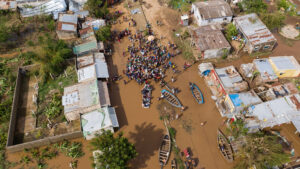
Cyclone Ditwah struck Sri Lanka in late November 2025 and caused catastrophic flooding and landslides driven by exceptionally intense and persistent rainfall. The accumulated rainfall associated with Ditwah exhibited return periods exceeding 100 years, locally surpassing 1,000 years across the country. Diagnostic analysis shows that the cyclone developed under highly favorable environmental conditions, including sea surface temperatures exceeding 28°C, anomalously moist mid-tropospheric conditions, and weak vertical wind shear. Here we assess the role of anthropogenic climate change in shaping the intensity and frequency of Cyclone Ditwah-like events using a combination of event-based attribution and large-ensemble climate simulations. A storyline-based pseudo-global warming framework with convection-permitting simulations shows that warming substantially amplified both the magnitude and spatial extent of cyclone-associated heavy rainfall (9.4%/K for domain-mean rain), primarily through enhanced latent heat flux, increased atmospheric moisture, and greater mid-tropospheric instability. Our analysis using a large-ensemble (d4PDF) tropical cyclone dataset reveals a decrease in the overall frequency of Ditwah-like cyclones under warming, accompanied by a pronounced increase in high-intensity events. Together, these results indicate a nonlinear cyclone response to climate change, characterized by fewer but more intense rainfall-producing systems.
Copyright (c) 2026 The Author(s) CC-BY 4.0