
Yohei Arata, Hirotaka Saito, Takashi Gomi, Roy C. Sidle
Received 25 April, 2025
Accepted 5 December, 2025
Published online 27 February, 2026
Yohei Arata1), Hirotaka Saito2), Takashi Gomi3), Roy C. Sidle4)5)
1) Forestry Research Institute, Hokkaido Research Organization, Japan
2) Institute of Agriculture, Tokyo University of Agriculture and Technology, Japan
3) Graduate School of Bioagricultural Sciences, Nagoya University, Japan
4) Mountain Societies Research Institute, University of Central Asia, Tajikistan
5) Yamano Bosai, Japan
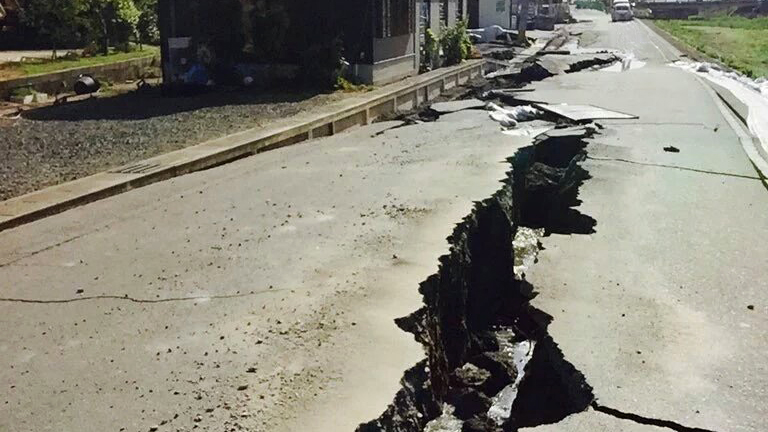
Earthquake-induced fissures alter near-surface hydrological processes; however, their effects on vertical water movement in layered volcanic soils remain poorly understood. This study aims to elucidate how such fissures affect infiltration dynamics in stratified volcanic soil profiles. A one-dimensional Richards’ equation model (HYDRUS-1D) was applied to simulate water flow in three soil profiles: a reference profile (R1) representing pre-earthquake conditions, and two fissure-containing profiles (F1 and F2) differing in fissure depth and exposed layers. Model parameters were inversely estimated from field-observed pressure head and volumetric water content in R1, providing a reliable baseline for simulations in F1 and F2. The simulations revealed that fissures allowed water to bypass surface horizons and enhance vertical infiltration. Variations in fissure depths and exposed subsurface layers primarily influenced simulated drying patterns. In particular, simulations showed stronger drying beneath the deeper fissure (F2) due to evaporative loss, whereas field observations indicated slower recession, likely reflecting lateral or vertical drainage constrained by structural transitions in the layered soil. These findings underscore the need for future modeling to incorporate and parameterize water retention and flow behavior under abrupt stratigraphic and structural changes to better capture subsurface water dynamics beneath fissures.
Copyright (c) 2026 The Author(s) CC-BY 4.0